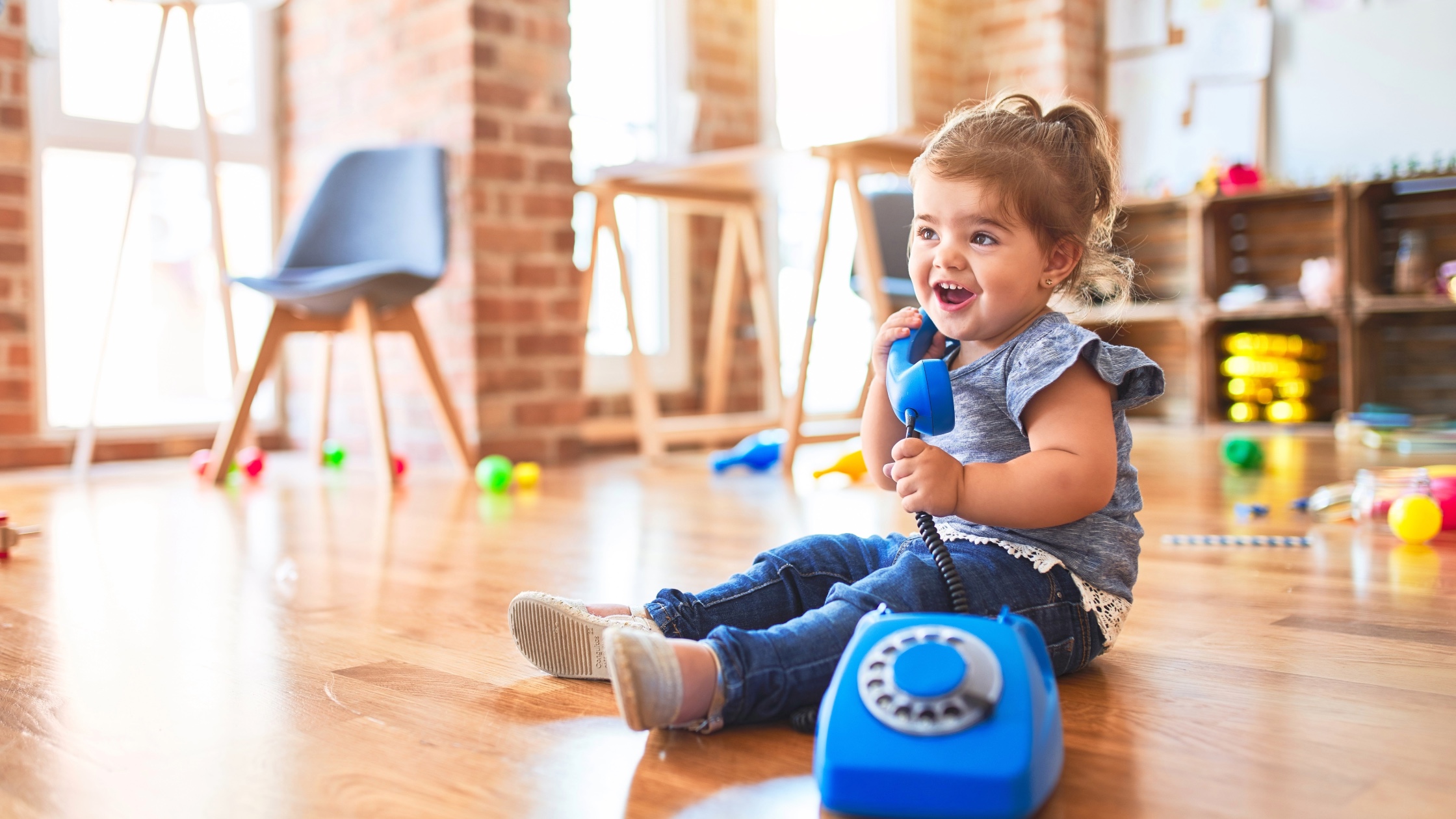
Most parents eagerly await their baby's first words. Will it be dada or mama or something entirely different? My child chose “nana” because she loved bananas. My husband and I went with it because we knew it was just the beginning.
Yet many parents find themselves comparing what their child is doing and saying with what their friends' kids the same age are doing and saying. Communication is the beginning of a long developmental process. One that varies from child to child, even within families. So instead of comparing, use this blog as a resource for what the average child can do at different ages and stages of toddlerhood, and how you can help support their development.
What’s typical at 12, 18, and 24 months
These milestones come from the CDC’s current developmental checklists and from the American Speech-Language-Hearing Association (ASHA), which describe what most children can do by each age. We emphasize the word most, because it matters. A child who is a little behind on one item is not automatically delayed, and a child who is ahead on words may be behind on something else. Think of this list as a set of mile markers, not a report card.
By 12 months, most children:
- Wave “bye-bye”
- Call a parent “mama,” “dada,” or another special name.
- Understand “no” (they pause or stop when you say it, even if they do not always obey)
By 15 months, most children:
- Try to say one or two words besides “mama” or “dada,” even a shortened version like “ba” for ball.
- Look at a familiar object when you name it.
- Point to ask for something or to get help.
By 18 months, most children:
- Try to say three or more words besides “mama” or “dada”
- Follow a one-step direction without any gestures, like “Give me the cup”
- Point to show you something interesting, like a plane overhead
- Look around when you ask a “where” question, like “Where is your blanket?”
- Point to one or more body parts when asked
- Use a mix of long strings of sounds, syllables, and real words that sound like a sentence, even if you cannot make out most of it.
By 24 months, most children:
- Say at least two words together, like “more milk”
- Point to things in a book when you ask, like “Where is the bear?”
- Point to at least two body parts when you ask
- Use more gestures than waving and pointing, like blowing a kiss or nodding yes.
- Follow two-step directions, like “Get the spoon and put it on the table”
- Use words such as “me,” “mine,” and “you,” and ask for help
Speech-language pathologists also look for a more expansive vocabulary by the end of the second year. Those words do not have to be clear. “Wawa” counts for water, and so does a word only you can decode.
By 30 months, most children:
- Put two or more words together, including an action word, like “doggie run”
- Name things in a book when you point and ask.
- Use words like “I,” “me,” or “we”
Between 2 and 3 years: children start answering simple questions like “What do you do when you are sleepy?”, asking “why” and “how,” adding plurals and “-ing” endings, and saying “Look at me!” Their speech becomes clearer, though strangers may still struggle to understand them.
Communication is more than words
As you likely know, communication is much more than words. As your child begins their communication journey, remember that communication is more than words.
ASHA describes social and gestural communication in toddlers this way: they point to make requests, comment on things, or get information. They shake their heads for “no” and nod for “yes.” They use gestures when excited, like clapping and high-fives, or when being silly, like sticking out their tongue or making funny faces.
When we talk with parents about speech, we often ask the following questions:
- Does your child look at you when you talk to them?
- Do they point to show you things, not only to ask for things?
- Do they respond when you call their name?
- Do they follow simple directions, even if they cannot say much back?
- Do they use gestures, sounds, and facial expressions to get a message across?
A toddler who says only a few words but understands everything, points constantly, and checks in with your face is in a very different place than a toddler who is quiet in every way and avoids facial contact. The first child is communicating and working toward talking. The second may require further evaluation.
Hearing may also affect speech development. If we suspect a hearing issue, we can refer to an audiologist or speech-language pathologist for a full assessment.
For families who speak more than one language at home, it is perfectly normal for a bilingual toddler to mix languages or have a smaller vocabulary in each language. Parents should feel comfortable speaking whatever language they use most at home. This won't affect their child’s ability to be bilingual in the future.
What you can do at home to support language development
A big part of helping children develop language is using lots of words when interacting with them. First, talk slowly and use clear, short sentences with simple words. Use the real names for objects and body parts, instead of cute substitutions. This includes body parts. Be patient and let your child finish speaking without correcting them. If your child says, “ba” and holds up a ball, you say, “That’s right, it’s a ball!”
One thing we recommend for every parent and caregiver is reading to their child every day. Doing so will dramatically support vocabulary development and, eventually, reading.
When waiting is an issue
As we’ve already shared, language development varies from child to child. While plenty of toddlers who appear delayed catch up on their own, some stay quiet and then start speaking in full sentences.
The trouble is that nobody can tell ahead of time which quiet toddler is which. The early years matter most because a toddler’s brain builds language pathways quickly.
That is why the CDC’s current guidance tells parents to act early and not to wait. ASHA says the same, just in its own way: each child develops at their own pace, but if your child isn't meeting many of the milestones for their age range, an assessment is worth it.
Talk to us if:
- Your child is not meeting one or more of the milestones above for their age.
- Your child had words or gestures but seems to be using fewer of them lately (we always want to hear about this one right away).
- Your child does not seem to respond to sounds or to their name.
- Your child is not pointing, waving, or using gestures by 12 to 15 months.
- You feel something is off, even if you cannot name it.
That last is important. Parents spend more time with their child than anyone, and we don’t take a gut feeling lightly.
What a speech evaluation entails
At Little Oaks Pediatrics, a speech evaluation usually begins with a regular visit and a conversation.
We ask what words and gestures you are seeing, how your child plays, how they respond to you, and what a typical day looks like. Jot down what you notice whenever you think of it, and bring those examples to the appointment. A short video of your toddler at home helps a lot, because kids often go quiet in the exam room.
During the appointment, we are looking at the whole child. This includes a physical exam and a hearing assessment, since hearing can affect speech. We also watch how your child plays and interacts during the visit.
After the appointment, we will discuss next steps. Sometimes that means checking back in a few months, and sometimes it means a referral for a hearing test, a speech-language evaluation, or an early intervention evaluation.
How early speech support works in Wake County
If your toddler is under three and you're concerned about a delay, North Carolina has a state program built just for this. It is called the North Carolina Infant-Toddler Program and is offered through the Raleigh Children’s Services Developmental Agency (CDSA).
You can refer your child directly by phone, email, fax, letter, or in person. You do not need a doctor’s referral to begin, though we are happy to provide one and send along our notes.
CDSA provides evaluation and service coordination at no cost to families.
Evaluations can take place at home, at a childcare center, or in another setting that is familiar to your child. If your child is eligible and your family enrolls, the plan (called an IFSP) happens within 45 days of the referral.
The CDSA determines eligibility using standardized measures, family interviews, and observation. We cannot promise the outcome, but we can help you get there.
The Raleigh CDSA is located at 1100 Navaho Drive, Suite 100 in Raleigh. Their phone number is (919) 664-1800. You can also find your local office through the North Carolina Infant-Toddler Program page on the NCDHHS website.
For children turning three, the CDSA service coordinator helps plan the transition to the next stage. At that age, preschool services through the public school system can pick up where early intervention left off, and your provider can help you understand how that works.
How we can help
If your toddler is 12 to 36 months and you're concerned about their language development, schedule a visit or call us at (919) 720-4876. Tell the front desk it is a speech or development question so we can set aside enough time. You can also bring up your concerns during a well visit.
We are here to support you and your child. Please do not hesitate to reach out anytime with questions or concerns.

 6 min read
 Download
 Share